 Lunch-Box
Dream Lunch-Box
Dream
by Tony Abbott
Ages 10–14
It’s the summer of 1959 and Bobby
is on a trip to visit Civil War battlefields with his
mother, older brother, and recently widowed grandmother.
Bobby is not comfortable around “chocolate colored” people
or death, so the trip from Ohio to Florida is difficult
for him. Interwoven with Bobby’s narration is the story
of a black family in Georgia, told from a variety of
first-person viewpoints. This beautifully written books
deals with the uncomfortable subjects of racial conflict,
sibling rivalry, and marital discord. |
|
 Chains Chains
by Laurie Halse Anderson
Ages 10–up
As the Revolutionary War begins, 13-year-old
Isabel and her 5-year-old sister Ruth are about to be freed
from slavery by the will of their Rhode Island mistress. However,
the unscrupulous heir prevents the reading of the will and
the girls are soon the property of an abusive Loyalist couple
in New York. Isabel agrees to spy for the Patriots in exchange
for passage back to Rhode Island for herself and her sister.
This well researched exploration of the treatment of slaves
is contained in a gripping story. |
|
 Forge Forge
by Laurie Halse Anderson
Ages 10–up
This sequel to Chains is
narrated by Curzon, the young slave Isabel freed from prison
while escaping from New York City in 1777. After staying for
a few months in New Jersey, Isabel runs away to find her sister,
a quest Curzon feels is futile. Curzon joins the army, passing
as a freed slave, and suffers through the harsh winter at Valley
Forge. His fragile acceptance is threatened when his owner
arrives. Readers will be anxious to read the final book in
the trilogy to learn the fate of Curzon and Isabel. |
|
 Ashes Ashes
by Laurie Halse Anderson
Ages 10–14
It’s June 1781, and former slaves Isobel and Cruzon have finally located Isobel’s younger sister Ruth on a South Carolina plantation. Now 12, Ruth has been cared for by the other plantation slaves, and has no use for her sister. Isobel doesn’t understand Curzon’s desire to enlist in the fight for independence. Taking Ruth and Aberdeen, an escaped slave from the plantation, they head north to Williamsburg, Virginia, where patriots are preparing for an assault on Yorktown. This gripping story is a satisfying conclusion to the Seeds of America trilogy (Chains, Forge). |
|
 The
Astonishing Life of Octavian Nothing, Traitor to the Nation,
Volume 1: The Pox Party The
Astonishing Life of Octavian Nothing, Traitor to the Nation,
Volume 1: The Pox Party
by M.T. Anderson
Ages 14–up
Octavian, a black youth in Revolution-era
America, is raised in a Boston household of radical philosophers.
He is given a classical education and kept with his mother,
an African princess, in comfort. As he matures, Octavian
realizes he is an experiment to discover the intellectual
capability of Africans. When his mother dies, Octavian
runs away and joins the Patriot army. Though written
in 18th century language in the form of letters, this
powerful novel raises contemporary issues of racism,
human rights, the causes of war, and the struggle of
an individual to define himself. |
|
 The
Astonishing Life of Octavian Nothing, Traitor to the Nation,
Volume II: The Kingdom on the Waves The
Astonishing Life of Octavian Nothing, Traitor to the Nation,
Volume II: The Kingdom on the Waves
by M.T. Anderson
Ages 14–up
Octavian heads to Virginia where
Lord Dunmore, the colony’s governor, is emancipating
slaves in exchange for military service. Octavian soon
realizes that his liberation is not a moral decision,
but a political expediency. As the Revolutionary War,
explodes around him, Octavian struggles with ideals of
liberty and his own personal growth in this fascinating
perspective on our national origins. (sequel to The
Astonishing Life of Octavian Nothing, Traitor to the
Nation, Volume 1: The Pox Party) |
|
 City
of Orphans City
of Orphans
by Avi, Greg Ruth
Ages 10–14
Maks Geless, a 13-year-old Danish
immigrant, makes 8¢ a day selling newspapers on the street
corners of 1893 Manhattan to help support his family.
Things aren’t easy for the Geless family: the shoe factory
where Mr. Geless works is closing, Maks’s sister Agnes
has tuberculosis and his sister Emma, a maid at the Waldorf
Hotel, is accused of stealing. But the Geless family
finds room in their humble home for Willa, a homeless
girl who saves Maks from a street gang. Maks and Willa
join forces to clear Emma’s name and rescue her from
the Tombs, the city’s infamous prison. The stark contrast
between the struggles of the Geless family to survive
and the easy splendor of the Waldorf make this historical
fiction come alive. |
|
 Crispin:
The Cross of Lead Crispin:
The Cross of Lead
by Avi
Newbery Medal 2003
Ages 10–14
Set in 14th century England, Crispin
is a 13-year-old illiterate peasant who flees his village after
being accused of a crime he did not commit on the day of his
mother’s death. He hopes that the words on his mother’s lead
cross will provide a clue to his unknown father. He falls in
with Bear, a huge traveling juggler, and their relationship is
the heart of the book. |
|
 The
Seer of Shadows The
Seer of Shadows
by Avi
Ages 9–12
This scary ghost story, set in
19th century New York City, is narrated by 14-year-old
Horace Carpentine, apprentice to a photographer intent
on duping a wealthy client. |
|
 Sophia’s War: A Tale of the Revolution Sophia’s War: A Tale of the Revolution
by Avi
Ages 8–12
Sophia Calderwood (12) lives in British-occupied New York City on the eve of the Revolutionary War. When her brother William, a Patriot soldier, goes missing at the Battle of Brooklyn, Sophia searches for him in the prisons where rebels are held. When she witnesses the execution of Nathan Hale three years later, she is horrified and resolves to do all she can to help the American cause. Recruited as a spy, she is sent undercover as a maid in General Clinton’s household, the supreme commander of the British forces in America, eventually uncovering the truth about Benedict Arnold. |
|
 The Passion of Dolssa The Passion of Dolssa
by Julie Berry
Ages 12–up
In 1241 Provensa (Provence) the inquisition seeks to rid the Christian world of heretics. Dolssa de Stigata’s mother was condemned by a Dominican friar to burn at the stake, but Dolssa escapes. She is rescued by Botille, a young matchmaker who runs a tavern with her two sisters in the seaside town of Bajas. They try to keep the fugitive hidden, but Dolssa feels called to heal the sick and her small miracles bring the wrath of the Church to Bajas, endangering everyone in the small town. |
|
 The Scandalous Sisterhood of Prickwillow Place The Scandalous Sisterhood of Prickwillow Place
by Julie Berry
Ages 10–14
The students of St. Etheldreda’s School for Young Ladies in Cambridgeshire England have a problem — their stern headmistress Constance Plackett and her despised brother drop dead at the dinner table, apparently poisoned. The girls decide to pretend that everything is normal while hunting for the murderer. This hilarious Victorian farce is full of mystery, surprising plot twists, and a hint of romance. |
|
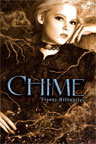 Chime Chime
by Franny Billingsley
Ages 12–up
Briony (17) believes she is a witch.
Her step-mother blamed her for all the family’s hardships,
including her twin sister’s disabling fall from a swing years
earlier. Briony also blames herself for her step-mother’s death
and often escapes to the swamp to tell her secrets to the Old
Ones. New technology has arrived in her tiny town of Swampsea,
England, with the turn of the 20th century, and a new pumping
station is built to drain the bog. But the supernatural Old
Ones have sent a fever to punish Swampsea. Then Eldric arrives,
and Briony is torn between her attraction to Eldric and her
overwhelming guilt. |
|
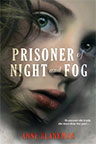 Prisoner of Night and Fog Prisoner of Night and Fog
by Anne Blankman
Ages 13–up
Gretchen Müller has been her Uncle Dolf’s favorite ever since her father sacrificed himself to shield him from police bullets during his failed attempt to overthrow the government in 1923. Then Gretchen meets Daniel Cohen, a reporter who believes that her father is not a Nazi hero, but instead a murder victim. Gretchen doesn’t believe Daniel, and begins her own investigation, discovering that many things she accepted as truths are really lies, and that her Uncle Dolf (Adolf Hitler) is not the man she thought he was. |
|
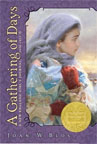 A
Gathering of Days: A
Gathering of Days:
A
New England Girl’s Journal, 1830-32
by Joan W. Blos
Newbery Medal 1980
Ages 9–12
This novel is written in the form of
a diary kept for a year by Catherine Cabot Hill, a 13-year-old
girl in New Hampshire. Catherine’s mother has died, and she must
keep house for her father and younger sister. During the year,
Catherine undergoes school discipline, encounters runaway slaves,
loses a friend, and faces new relationships when her father remarries
a woman with children of her own. |
|
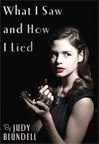 What
I Saw And How I Lied What
I Saw And How I Lied
by Judy Blundell
Ages 12–up
This noir mystery is set in 1947.
Evie (15) and her mother set off for Florida with her
stepfather Joe. Evie falls in love with Peter, an army
buddy of Joe’s. A suspicious boating accident forces
Evie to re-examine her relationships with Peter, her
mother, and her stepfather. This stylish novel has the
atmosphere of a glamorous old movie. |
|
 Strings
Attached Strings
Attached
by Judy Blundell
Ages 13–up
Kit Corrigan (17) leaves her
home in Providence, Rhode Island, hoping to find fame
and fortune on Broadway. It’s 1950, and Billy, Kit’s
ex-boyfriend, has joined the army, but his mob-connected
father offers Kit a Manhattan apartment and a nightclub
job if she agrees to keep him informed about Billy
and his friends. Soon Kit is way over her head, caught
in a web of intrigue, love, betrayal, and murder. |
|
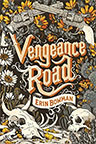 Vengeance Road Vengeance Road
by Erin Bowman
Ages 14–up
It’s 1887 when Kate Thompson’s father is killed by the Rose Riders, searching for a mysterious journal that reveals the secret location of a gold mine. Disguised as a boy, Kate (18) sets off west in search of vengeance. She is joined by Jesse and Will Colton, brothers in search of gold, and guided by Liluye, an Apache girl. This vivid portrayal of a lawless world doesn’t shrink from violence. |
|
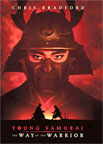 Young
Samurai: The Way of the Warrior Young
Samurai: The Way of the Warrior
by Chris Bradford
Ages 10–up
A British merchant ship is
attacked by Japanese ninja pirates who murder the entire
crew, including Jack Fletcher’s father. Young Jack
is rescued by a powerful Samurai who adopts him and
trains him to join the warrior class. Since he is a
foreigner, Jack is treated as an outcast at Samurai
school and must use all his wit and skill to survive
and succeed. First in a projected trilogy, this fast-paced
adventure set in medieval Japan is full of spellbinding
bits of history, culture, and martial arts. |
|
 To Stay Alive: Mary Ann Graves and the Tragic Journey of the Donner Party To Stay Alive: Mary Ann Graves and the Tragic Journey of the Donner Party
by Skila Brown
Ages 10–14
This compelling novel in verse is written from the fictionalized perspective of real-life Mary Ann Graves, one of the few survivors of the Donnor Party. In 1846, Mary and her family left Illinois to settle in California. At first Mary shares her father’s excitment about the adventure, but the reality of life on the trail is not what she expected. Mary cares for her younger siblings, helps move rocks and trees blocking the wagons, and endures thirst in the desert. The worst is the final ordeal when they become trapped in the ice and snow at Donnor Pass, resorting to cannibalism in order to survive. |
|
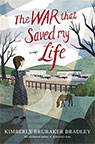 The War that Saved My Life The War that Saved My Life
by Kimberly Brubaker Bradley
Ages 9–12
Ada (9) lives with her younger brother Jamie and her mother in WWII London. Because Ada was born with a clubfoot, her mother is ashamed of her and never lets her leave the apartment, abusing her both physically and emotionally. When the Germans begin bombing London and children are evacuated to the country, Ada sneaks onto the train with Jamie. None of the villagers are willing to take the neglected siblings, so they are sent home with Susan Smith, a reclusive woman with no experience with children. Miss Smith provides the children with food, new clothing, and the security they have never know. She also has a pony, which Ada is determined to learn to ride and earn the freedom to roam the countryside at will. |
|
 Kaleidoscope
Eyes Kaleidoscope
Eyes
by Jen Bryant
Ages 9–13
In the summer of 1968, 13-year-old
Lyza and her friends search for Captain Kidd’s lost treasure
in their New Jersey neighborhood. Narrated in verse,
this novel has a strong sense of place and vividly portrays
a teenager’s conflicting emotions about the onset of
adulthood. |
|
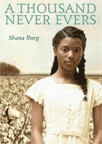 A
Thousand Never Evers A
Thousand Never Evers
by Shana Burg
Ages 9–12
Set in rural Mississippi during the
civil rights movement, this emotionally compelling novel shows
the racism and violence endured by the African-American community
through Addie Ann Pickett, a junior high school girl. Caught
between her mother’s rule to stay away from trouble and her
brother and minister who argue that there comes a time when
dignity is worth more than life, Addie has to make some difficult
decisions. |
|
 Ringside
1925: Ringside
1925:
Views from the Scopes Trial
by Jen Bryant
Ages 12–up
The fictionalized inhabitants of
Dayton, TN, home of the infamous “monkey trial,” speak
in a range of perspectives about the teaching of evolution. |
|
 Al Capone Does My Homework Al Capone Does My Homework
by Gennifer Choldenko
Ages 10–up
Moose Flanagan (13) is happy when his father is promoted to associate warden at Alcatraz, but the good fortune makes the family a target. A fire breaks out while Moose and his autistic sister Natalie are alone in their apartment. Moose is afraid it is his fault since he fell asleep, and a neighbor blames Natalie for the fire. Moose and the other Alcatraz kids band together to figure out the cause of the fire. Inmate No. 85 (Al Capone) sends Moose a note on his homework that helps solve the mystery. This final trilogy volume follows Al Capone Does My Shirts and Al Capone Shines My Shoes. |
|
 Ghost Hawk Ghost Hawk
by Susan Cooper
Ages 10–14
Returning from his three-month test of solitude, Little Hawk returns to his Pokanoket village to discover that diseases brought by the Pilgrims in nearby Plymouth have killed everyone except his grandmother. Later Little Hawk befriends a Pilgrim boy named John Wakely, but the Pilgrims’ bigotry and a shocking act of violence permanently change both their lives. |
|
 Bud,
Not Buddy Bud,
Not Buddy
by Christopher Paul Curtis
Newbery Medal 2000
Ages 9–12
Bud is a 10-year-old orphan in Depression-era
Michigan. He runs away to Grand Rapids, searching for the man
he believes might be his father, jazz musician Herman E. Calloway.
Along the way Bud has all sorts of exciting adventures, narrated
in his own authentic and often hilarious voice. Calloway is less
than thrilled to meet Bud, but the other members of his band
make Bud feel at home. |
|
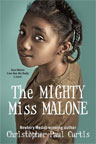 The
Mighty Miss Malone The
Mighty Miss Malone
by Christopher Paul Curtis
Ages 10–14
In 1936 Gary, Indiana, the
Great Depression causes Roscoe Malone to lose his job.
He leaves for Flint hoping to find another job, leaving
his wife, son Jimmy, and daughter Deza (12) behind.
When Deza’s mother also loses her job, the family becomes
homeless and sets off to Flint. In a camp on the journey,
Jimmy’s beautiful voice is recognized, and he leaves
to pursue a career as a performer. Deza and her mother
find a new home and cling to the hope that they will
find her father. (Deza makes an appearance as a minor
character in Bud,
Not Buddy.) |
|
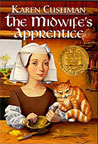 The
Midwife’s Apprentice The
Midwife’s Apprentice
by Karen Cushman
Newbery Medal
1996
Ages 10–up
In medieval England, a young girl rises
from dire poverty by becoming the apprentice to Jane Sharp, a
cranky and bossy midwife. First known as Beetle, since she was
found living in a dung heap, the girl struggles to learn the
skills of her new profession. As she grows in knowledge and self-confidence,
the girl finally respects herself enough to choose a real name:
Alyce. |
|
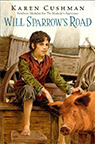 Will Sparrow’s Road Will Sparrow’s Road
by Karen Cushman
Ages 10–14
Abandoned by his mother and sold to an innkeeper for an unlimited supply of ale by his father, Will Sparrow (13) is a self-confessed liar and thief. Running away from the inn, Will sets out on the open road, trying to outsmart the thieves, tricksters, and con artists, and repeatedly being taken advantage of. Will finally ends up with Master Tidball and his caravan of oddities, befriending Grace, a girl billed as a monster because of the silky hair growing on her face. Elizabethan England comes to vivid life in this lively and amusing tale. |
|
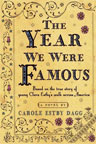 The
Year We Were Famous The
Year We Were Famous
by Carole Estby Dagg
Ages 12–up
Clara (17), who dreads settling
down with the boring young farmer who wants to marry
her, is convinced by her mother to take a 4,000 mile
walk to save their farm from foreclosure. Inspired
by Nellie Bly's trip around the world, Clara’s mother
accepts a $10,000 challenge from a publisher to walk
from Washington state to New York City in seven months.
Based on the real journey taken by the author’s great-aunt
and great-grandmother, this exciting book recreates
the hardships and adventures the two women faced as
they learned to rely on each other and the kindness
of strangers to find food and shelter along the trek. |
|
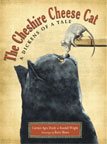 The
Cheshire Cheese Cat: A Dickens of a Tale The
Cheshire Cheese Cat: A Dickens of a Tale
by Carmen Agra Deedy, Randall
Wright, Barry Moser
Ages 8–12
Skilley is an alley cat who
longs for a comfortable life at the Cheshire Cheese
Inn, the pub where Charles Dickens is struggling to
write the opening of his new novel. When given the
job of mouser, Skilley strikes a bargain with Pip,
the lead mouse: Skilley will protect the mice if they
supply him with the tasty Cheshire cheese produced
by the inn. The unlikely pair work together to restore
Maldwyn, a wounded raven, to his rightful place serving
Queen Victoria in The Tower. This delightful book is
beautifully illustrated. |
|
 Titanic
Sinks! Titanic
Sinks!
by Barry Denenberg
Ages 10–up
This intriguing mix of fact
and fiction gives a “you are there” feeling
to the infamous disaster, commemorating 100th anniversary
of the sinking of the Titanic. Fictional characters
supplement the recollections of actual survivors, presented
in the pages of a fictional magazine. Period photographs
add to the dramatic effect. |
|
 Annexed Annexed
by Sharon Dogar
Ages 12–up
On July 13, 1942, 15-year-old Peter
van Pels and his family entered the attic that would be their
home for two years. Written from the viewpoint of 15-year-old
Peter van Pels, this captivating historical novel presents
a boy struggling to understand himself, religion, and the members
of the Frank family who share the small living space. Peter’s
growing interest in Anne will intrigue readers of The
Diary of Anne Frank. Ending with reports from the death
camps of Auschwitz and Mauthausen, Peter struggles to maintain
his sense of identity to the very end. |
|
 These Shallow Graves These Shallow Graves
by Jennifer Donnelly
Ages 12–up
It’s 1890 and rich and beautiful Josephine Montfort is expected to marry a suitable man as soon as she graduates from Miss Sparkwell’s School for Young Ladies in New York City. Secretly, Jo dreams of becoming a newspaper reported like Nellie Bly. When Jo’s father is found dead, presumably in an accident while cleaning his pistol, Jo knows he was far too smart to clean a loaded gun. She doesn’t believe the rumors of suicide either, and teams up with Eddie Gallagher, a young reporter, to discover the truth. |
|
 Anybody Shining Anybody Shining
by Frances O’Roark Dowell
Ages 10-12
Arie Mae Sparks (12) is imaginative and full of energy, and considered a bit strange by her small 1920s North Carolina town. Arie Mae longs for a true friend, a friend that shines, but she doesn’t have much choice in her small community. Arie Mae begins writing letters to a distant cousin she has never met, hoping she might be the friend she needs. Then a visiting boy named Tom catches her interest. He limps, and isn’t a girl, but Arie Mae is sure a light shines from inside him, as she confesses in a letter to her cousin Caroline, who never answers her letters. |
|
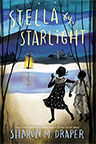 Stella by Starlight Stella by Starlight
by Sharon M. Draper
Ages 9–13
Stella (11) lives in segregated 1932 Bumblebee, North Carolina. Some stores she can go inside, others she can’t. But at least the Ku Klux Klan hasn’t bothered their community for years. But one night Stella and her little brother are out late at night and witness a meeting of the Klan, a signal of trouble to come to the black community of Bumblebee. Stella envies the fine school buildings for the white children and dreams of becoming a writer. Her father is equally determined to vote. This compelling story of a community that comes together to find the strength to fight injustice features a humble heroine who doesn’t recognize the power of her own words. |
|
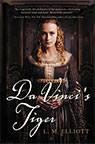 Da Vinci’s Tiger Da Vinci’s Tiger
by L.M. Elliott
Ages 13–up
Ginevra de’ Benci (17) is the pampered daughter of a wealthy family trapped in an unfullfilling arranged marriage in Renaissance Florence. Bernardo Bembo, the new ambassador from Venice, introduces Ginevra to a stimulating group of artists and philosophers and their patrons. Bembo chooses Ginevra as his Platonic muse and commissions her portrait by the young Leonardo da Vinci. During the long sessions posing for the portrait, Ginevra bonds with the talented painter. This intriguing novel is based on the real-life Ginevra de’ Benci who posed for one of Leonardo da Vinci’s earliest masterpieces. |
|
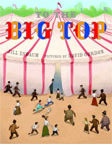 To
the Big Top To
the Big Top
by Jill Esbaum
Ages 5–8
Benny and his friend Sam land
jobs helping with the elephants when the circus comes
to town. As the boys move from backstage to choice seats
in the Big Top, this book captures the excitement of
the circus arriving in small town America in the late
1800s. |
|
 March
On! The Day My Brother Martin Changed The World March
On! The Day My Brother Martin Changed The World
by Christine King Farris, London
Ladd
Ages 9–12
Christine
King Farris, Martin Luther King, Junior’s older
sister describes the 1963 March on Washington with an
intimate down-to-earth perspective, presenting her brother
as a man rather than as an icon. |
|
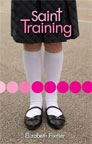 Saint
Training Saint
Training
by Elizabeth Fixmer
Ages 9–12
It’s the late 1960s, and sixth-grader
Mary Clare longs for the quiet orderly life of the
convent. The fourth of nine children in a Catholic
family in a small town in Wisconsin, Mary Clare works
hard to help her mother maintain some sort of order
in their chaotic household, while writing letters to
a Mother Superior, describing her daily life and hopes
for the future. Mary Clare’s older brothers argue about
the Vietnam War (one wants to enlist, the other applies
for conscientious objector status), her mother is depressed
with yet another pregnancy, and Mary Clare struggles
for acceptance among her Protestant neighbors and at
school where she feels ashamed of her poverty. This
painfully honest novel is both funny and hopeful. |
|
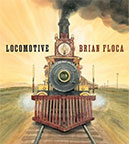 Locomotive Locomotive
by Brian Floca
Ages 4–10
It’s the summer of 1869, and the Transcontinental Railroad has just been completed. A mother and her two children board the train in Omaha, leaving their old home behind to join Papa who has gone ahead to Sacramento, California to prepare their new home. Details about the construction of the railroad and the crew it takes to run the train provide background to the small family enjoying the cross-country journey. |
|
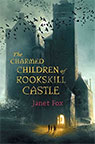 The Charmed Children of Rookskill Castle The Charmed Children of Rookskill Castle
by Janet Fox
Ages 10–up
Katherine (12) and her two younger siblings are sent away from London along with a group of classmates to keep them safe during the bombings of the 1940s Blitz. Rookskill Castle, owned by a distant relative, is an ancient place in the Scottish highlands. But the castle appears to be haunted, and by something far more dangerous than ghosts. Kat believes that Lady Eleanor is hiding a Nazi spy, but when her classmates begin disappearing one by one she fears that the danger may be even older and more terrifying. |
|
 Dreams
of Significant Girls Dreams
of Significant Girls
by Cristina García
Ages 12–up
This story of three girls who
spend summers in an exclusive boarding school in Switzerland
begins in 1971. The three girls from very different
backgrounds form a bond as they spend the summer as
roommates and the school year apart. Shirin is a pampered
Iranian, Ingrid is a sexually adventurous German-Canadian
with a talent for photography, and Vivien is a Cuban-Jewish
New Yorker with a flair for the culinary arts. The
boarding school setting provides an intriguing background
for this coming of age story celebrating the power
of female friendships. |
|
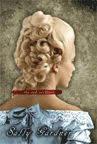 The
Red Necklace The
Red Necklace
by Sally Gardner
Ages 12–up
This suspenseful and haunting book
is set during the French Revolution. Yann Magoza, an orphan
traveling with a troupe of magicians, can read minds. While
performing at a castle, Yann meets Sidonie, the daughter of
a cruel marquis, and a scheming count murders one of the troupe
of magicians. |
|
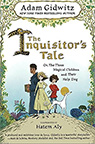 The Inquisitor’s Tale: Or, The Three Magical Children and Their Holy Dog The Inquisitor’s Tale: Or, The Three Magical Children and Their Holy Dog
by Adam Gidwitz, Hatem Aly
Ages 10–up
In 1242 France, travelers at an inn tell stories of three children and their dog Gwenforte, who miraculously returned from the dead. Jeanne is a peasant girl who can see the future, William is of African heritage and has amazing strength, and Jacob is a Jewish boy with the power to heal the sick. The travelers wonder if the three children are saints, frauds, or in league with the devil as they tell of their individual encounters with the trio. A flatulent dragon adds to the mystery and fun. |
|
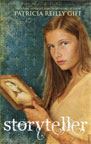 Storyteller Storyteller
by Patricia Reilly Giff
Ages 8–14
While staying with her aunt, Elizabeth
finds a portrait of Eliza, known as Zee, an ancestor who looks
just like her. Zee’s father died in the American Revolution,
and her mother when their cabin was ambushed. A map on the
back of the sketch helps Elizabeth puzzle out the story of
Zee’s life. As Elizabeth follows in Zee’s footsteps, the stories
of the two girls intertwine as each searches for inner strength
and a sense of belonging. |
|
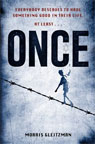 Once Once
by Morris Gleitzman
Ages 12–up
Everybody deserves to have something
good in their life at least once, believes Felix, a 10-year
old Polish Jew, who runs away from a Catholic orphanage to
search for his parents. After finding his home occupied by
hostile neighbors, Felix lives in hiding, in constant fear
of discovery, as he slowly becomes aware of the Nazi atrocities.
Felix’s traumatized present-tense narrative drives this powerful
novel which manages to find welcome bits of humor and heroic
kindness in the midst of horror and tragedy. |
|
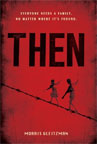 Then Then
by Morris Gleitzman
Ages 12–up
Felix (10) and Zelda (6) have escaped
from the train carrying Jews to the death camp, but as two
children alone in Nazi-occupied Poland they are surrounded
by danger. Felix uses his masterful storytelling skills to
create new denies for himself and Zelda, allowing them to live
safely in public for a time. Seeking to protect each other,
the two children secretly put a locket containing a picture
of Zelda’s Nazi parents among the other’s possession. They
form a family with a woman named Genia and begin to heal, but
with no certainty that their temporary safety will last. (sequel
to Once) |
|
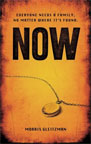 Now Now
by Morris Gleitzman
Ages 10–up
Felix is now a grandfather living in
Australia. His ten-year-old granddaughter Zelda continues the
story, describing the 2009 heat wave and devastating bush fires.
When Felix confronts some local bullies, Zelda gets a rare
glimpse into her grandfather’s past. Felix’s survivor’s guilt
and Zelda’s doubts that she will ever live up to the courage
of her namesake both come into play in this poignant close
to the powerful trilogy that began with Once and
continued in Then. |
|
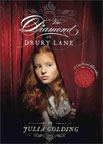 The
Diamond of Drury Lane The
Diamond of Drury Lane
by Julia Golding
Ages 10–14
Cat has lived in the Drury Lane
Theater Royal ever since she was abandoned as a baby
and taken in by Mr. Sheridan, the owner of the theater.
After Cat sees Mr. Sheridan hiding a valuable diamond,
she and her friends decide to help safeguard the treasure.
Set in 1790s London, England, this thrilling mystery
will keep readers glued to the pages. (first in a projected
quartet) |
|
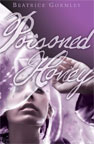 Poisoned
Honey Poisoned
Honey
A
Story of Mary Magdalene
by Beatrice Gormley
Ages 12–up
Mari (13) wants to be in control
of her own destiny, but women in 1st century Palestine
have little power, so Mari submits to an arranged marriage.
But her father and fiancé die of fever and Mari
finds herself at the mercy of others. An Egyptian wisewoman
teaches Mari the ways of the occult arts and she is gradually
consumed by evil spirits before her eventual redemption.
This biblical fiction brings the culture of early Palestine
to vivid life. |
|
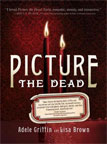 Picture
the Dead Picture
the Dead
by Adele Griffin, Lisa Brown
Ages 12–up
When Jennie’s twin brother
dies in the Civil War in 1864, Jennie feels his loss
like a wound. A year later, her cousin Quinn arrives
home to Massachusetts with the news that his brother
Will, Jennie’s fiancé, is also dead. Quinn, who is
much changed by the war, begins to court Jennie, who
responds though she senses that something mysterious
surrounds Will’s death. Jennie is haunted by both her
dead brother and Will, and suffers a recurring sensation
of being choked. Newspaper clippings, scrapbook entries,
and black-and-white drawings illustrate Jennie’s first
person narration in this effective gothic ghost story
portraying a country recovering from the horrors and
loss of war. |
|
 Ivy Ivy
by Julie Hearn
Ages 12–up
Two 19th century London women of the
Ragged Children’s Welfare Association rescue the orphan Ivy,
a Pre-Raphaelite beauty, who has been discarded by her family
as useless. The laudanum addicted Ivy spends most of her time
in a swoon, but the other characters scheme and frolic in this
lush absorbing novel. |
|
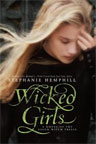 Wicked
Girls: A Novel of the Salem Witch Trials Wicked
Girls: A Novel of the Salem Witch Trials
by Stephanie Hemphill
Ages 12–up
It began as a girls’ game, but
ended as a witch hunt. When two village girls fall ill
and accuse neighbors as witches, Ann, Mercy, and Margaret
jump on the chance to have influence over others and
begin to accuse neighbors who have harmed them or their
families. Told in verse from each girl’s perspective,
this powerful novel explores the motivations that could
have driven the girls to make the false accusations that
resulting in the hangings of 19 people in 1692. And the
motivations are all too believable—jealousy, boredom,
longing for friendship and acceptance—inspiring uncomfortable
parallels to group dynamics of modern teens. |
|
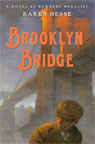 Brooklyn
Bridge Brooklyn
Bridge
by Karen Hesse, Chris Sheban
Ages 10–14
It’s 1903 in Brooklyn and all 14-year-old
Joseph Michtom wants to do is go to the brand-new amusement
park at Coney Island. But his Russian immigrant parents have
just invented the stuffed teddy bear, and Joseph is too busy
working to have fun. Meanwhile the street children living under
the Brooklyn Bridge are haunted by a ghost they call the Radiant
Boy. |
|
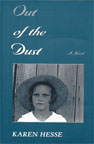 Out
of the Dust Out
of the Dust
by Karen Hesse
Newbery Medal 1998
Ages 11–up
Billie Jo (14) records the grim realities
of living in the Oklahoma dust bowl during the Depression. In
her free verse journal, she reveals her mother’s death and her
own burns in a fire and her father’s grief. Billie Jo’s hope
for a better future shines through all the pain and struggle
to survive. |
|
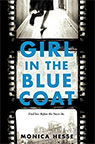 Girl in the Blue Coat Girl in the Blue Coat
by Monica Hesse
Ages 12–up
In 1943 Nazi-occupied Amsterdam, teenager Hanneke Bakker helps support her family by delivering black market goods while mourning the death of her boyfriend, killed on the Dutch front lines when the Germans invaded. Mrs. Janssen, one of her customers, asks for help locating Mirjam, a 15-year old Jewish girl who was hiding in a secret room in Mrs. Janssen’s home. Hanneke at first wants nothing to do with the dangerous search for the missing girl, but soon learns more than she wants to know about the horrors Jewish people are suffering under the Nazis, realizeing that refusing to join the underground resistance will make her part of the evil Nazi war machine. |
|
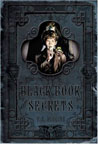 The
Black Book of Secrets The
Black Book of Secrets
by F.E. Higgins
Ages 10–14
Young Ludlow Fitch, fleeing a terrible
past, arrives in a peaceful village. Ludlow becomes the assistant
to the mysterious pawnbroker who trades cash for people’s deepest,
darkest secrets. It’s Ludlow’s job to record the secrets in
the leather bound Black Book of Secrets. The vaguely
Dickensian late 1800s atmosphere is the perfect backdrop for
this historical fantasy. |
|
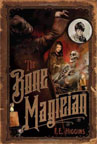 The
Bone Magician The
Bone Magician
by F.E. Higgins
Ages 10–14
Young Pin Carpue is left to survive
on his own in the crime-ridden city of Urbs Umida when his
father, a suspected murderer, disappears. Pin gets a job as
a corpse watcher, standing guard in the morgue for three days
to ensure that the deceased really are dead and not just sleeping.
There he meets the Bone Magician who claims to be able to reanimate
the dead to answer last questions from the living. This dark
and funny fantasy is a companion volume to The
Black Book of Secrets. |
|
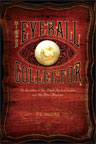 The
Eyeball Collector The
Eyeball Collector
by F.E. Higgins
Ages 10–14
Young Hector finds himself alone,
homeless, and penniless when his father dies after being
blackmailed and disgraced. Hector sets out to find revenge
against the man he thinks is responsible for the blackmail—Gulliver
Truepin, a one-eyed con artist who steals jewels to make
a different jeweled eyeball for each day of the week.
The two end up at Withypitts Hall, home of the cruel
Lady Mandible and all plots come together on the night
of an extravagant feast. (Companion volume to The
Black Book of Secrets and The
Bone Magician) |
|
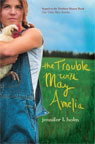 The
Trouble with May Amelia The
Trouble with May Amelia
by Jennifer L. Holm, Adam Gustavson
Ages 8–10
May Amelia (12) lives on a
farm in Washington state in 1900 with her parents,
Finnish immigrants, and seven brothers. Life is hard,
especially when your father doesn’t think girls are
worth much, but May Amelia manages to have plenty of
fun as she defends her beloved teacher from persistent
suitors. When Pappa asks May Amelia to translate for
a gentleman who is interested in buying their land,
she thinks she has finally earned her father’s respect,
until the gentleman turns out to be a scoundrel. A
salting of Finnish phrases and accurate historical
details spice up this historical fiction, a sequel
to Our
Only May Amelia. |
|
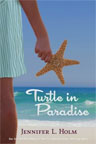 Turtle
in Paradise Turtle
in Paradise
by Jennifer L. Holm
Ages 8–12
Turtle (11) knows that life isn’t
like the happy Hollywood movies her mother adores. It’s
1935 and jobs are scarce, so when her mother gets a job
as a live-in housekeeper with a woman who doesn’t like
children, Turtle heads off without complaint to stay
with relatives she’s never met in Key West, Florida.
Turtle’s dreamy mother insists that Turtle is going to
live in paradise, but down-to-earth Turtle doesn’t expect
much. Eventually Turtle warms to her eccentric relatives
and begins to see the natural beauty hidden under the
trash. Turtle’s amusing first-person narration brings
the Depression era to vivid life. |
|
 The
Water Seeker The
Water Seeker
by Kimberly Willis Holt
Ages 10–14
Jake Kincaid is a skilled dowser,
a finder of water, but leaves that calling behind to
become a trapper in 1833. He returns a year later to
find that his wife has died, leaving him a baby named
Amos. Jake leaves Amos to be raised by his relatives
in Nebraska, returning each summer to visit. In 1841,
Jake brings his new Shoshone wife with him and they take
Amos with them to Missouri. When Amos is 13, the family
joins a wagon train headed west on the Oregon Trail.
The hardships of the journey are beautifully portrayed
in this historical coming-of-age novel. |
|
 Mao
and Me Mao
and Me
by Chen Jiang Hong
Ages 8–12
Chen’s direct and honest picture
book memoir of growing up during the Cultural Revolution
is an excellent representation of political upheaval
seen through the eyes of a child. Ink and wash paintings
document both beautiful moments and unpleasant events. |
|
 A Bandit’s Tale: The Muddled Misadventures of a Pickpocket A Bandit’s Tale: The Muddled Misadventures of a Pickpocket
by Deborah Hopkinson
Ages 8–12
Rocco Zaccara (11) is sold by his poverty-stricken parents to a padrone in New York City who compells his group of children to earn money by performing as street musicians. Rocco joins a band of pickpockets to save enough money to buy his way back home to Italy. He is uncomfortable stealing money until he meets Meddlin’ Mary, a young Irish girl who works with her father to take care of the city’s mistreated and overworked horses. First person narration brings this late 19th-century picaresque tale to life. |
|
 The Great Trouble: A Mystery of London, the Blue Death, and a Boy Called Eel The Great Trouble: A Mystery of London, the Blue Death, and a Boy Called Eel
by Deborah Hopkinson
Ages 10–up
Eel is an orphan and a mudlark, combing through the filthy banks of the Thames for anything he can sell to earn enough to survive. 1894 London is a dangerous place during the cholera outbreak, but Eel is also pursued by his evil stepfather. Polluted air is blamed for the cholera epidemic, but Eel and his mentor Dr. Snow believe the disease is being spread through a local water pump. This exciting tale mixes mystery, science, medicine, and history. |
|
 Hero on a Bicycle Hero on a Bicycle
by Shirley Hughes
Ages 10-14
1944 Florence is occupied by the Germans. Rosemary and her children, Paolo Crivelli (13) and his sister Constanza (16), feel isolated and oppressed by the Nazi security rules and the suspicion of their neighbors, who believe their absent father may be a Partisan, part of the pro-Allied resistance. Against all the rules, Paolo secretly violates curfew every night by riding his bicycle around the town. One night Paolo is approached by the Partisans, asking for his British mother’s help in sheltering escaped Allied prisoners of war. This tense historical thriller, told from the perspective of all three characters, captures the dangers and uncertainties of war. |
|
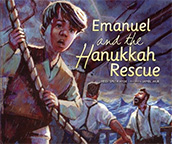 Emanuel and the Hanukkah Rescue Emanuel and the Hanukkah Rescue
by Heidi Smith Hyde, Jamel Akib
Ages 5–9
Emanuel and his father live in the whaling town of New Bedford, Massachusetts in the 18th century. Emanuel’s father lived as a secret Jew in Poland and still fears religious persecution, refusing to place the menorah lights in the window to celebrate Hanukkah. Emanuel stows away on the whaling ship, and when a storm overtakes the ship, the family menorah lights the way home. |
|
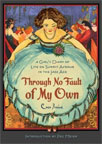 Through
No Fault of My Own: A Girl’s Diary of Life on Summit Avenue
in the Jazz Age Through
No Fault of My Own: A Girl’s Diary of Life on Summit Avenue
in the Jazz Age
by Coco Irvine
Ages 12–up
Clotilde “Coco” Irvine,
the daughter of a wealthy lumber baron, lived in a
mansion in St. Paul, Minnesota. Her diary from 1927,
the year she turned 13, presents a precocious and daring
girl who gets into frequent trouble at school and at
home. Recently discovered in the archives of the Minnesota
Historical Society, Coco’s diary is reprinted virtually
unchanged. Many entries begin, “I’m in deep trouble
through no fault of my own…” Coco’s descriptions
of her adventures, problems, and romances will captivate
modern readers as she explains her side of the messes
she created. |
|
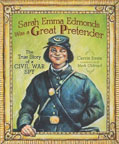 Sarah
Emma Edmonds Was a Great Pretender: The True Story of a Civil
War Spy Sarah
Emma Edmonds Was a Great Pretender: The True Story of a Civil
War Spy
by Carrie Jones, Mark Oldroyd
Ages 7–12
Sarah Emma Edmonds began pretending
at a young age. Her father wanted a son, so Sarah pretended
to be a boy. When she was a teenager, Sarah realized
she would never be the son her father wanted, so she
ran away from Canada to America, where she assumed
the identity of Frank Thompson. In 1861 she joined
the Union Army as a male nurse. When the Union Army
needed a spy, she volunteered, pretending to be a male
African American slave, a female Irish peddler, and
a female African American laundress in order to slip
behind enemy lines and gather information. Sly illustrations
capture Sarah’s joy in her successful deceptions. |
|
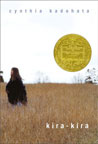 Kira-Kira Kira-Kira
by Cynthia Kadohata
Newbery Medal 2005
Ages 11–14
In the 1950s, when Katie is five, her
family moves from Iowa to Georgia, where there are few Japanese-Americans.
Katie’s older sister Lynn takes care of her while their parents
work long hours in the chicken-processing plant. Their roles
reverse when Lynn develops lymphoma. Through the illness and
Lynn’s death, Katie struggles to remember her sister as kira-kira,
glittering and shining. Narrated by Katie, this beautifully written
book tells a poignant story of love and loss. |
|
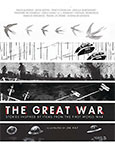 The Great War: Stories Inspired by Items from the First World War The Great War: Stories Inspired by Items from the First World War
illustrated by Jim Kay
Ages 12–up
Each of the 11 short stories in this collection marking the centenary of WWI was inspired by an artifact from the war. Striking black and white photographs accompany each story, by authors including David Almond, Michael Morpurgo, Marcus Sedgwick, and Sheena Wilkinson. |
|
 Dogs of War Dogs of War
by Sheila Keenan, Nathan Fox
Ages 8–12
The three historical fiction stories in this book focus on soldiers and their dogs in three different wars. In WWI, Marcellinus McDonald (16) is a doctor’s assistant on the Western Front in 1914, and Boots is his beloved “mercy dog,” who finds the wounded in No Man’s Land. Loki is a sled dog in a rescue unit stationed in 1942 Greenland, where his master relies on him in a solo encounter with some Nazis. The final story is about a boy named Henry in 1968 North Carolina whose struggles to control his beagle puppy bring him friendship with a recently returned Vietnam vet haunted by his experience on patrol with his German shepherd, Sheba. |
|
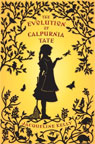 The
Evolution of Calpurnia Tate The
Evolution of Calpurnia Tate
by Jacqueline Kelly
Ages 10–up
Eleven-year old Calpurnia (Callie)
Tate is a middle child with six brothers in isolated
1899 Fentress, Texas. To her family’s distress, Callie
isn’t interested in normal girl occupations and would
rather learn about the natural world with her grandfather.
As Callie grows through the year of this book, she
gradually defines for herself what it means to be a
girl. (2010 Newbery Honor Book) |
|
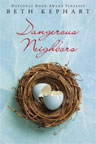 Dangerous
Neighbors Dangerous
Neighbors
by Beth Kephart
Ages 12–up
Katherine is still consumed
by grief over the death of her identical twin sister
Anna in a skating accident months ago. Feeling responsible
for her sister’s death, Katherine has decided to take
her own life, but is continually drawn to the wonders
of the 1876 Philadelphia Centennial Exhibition. Among
the crowds of strangers, Katherine loses herself in
memories of the past and her sister’s secret romance
with a “dangerous neighbor” that precipitated
the sequence of events leading to Anna’s death. Set
against a detailed background of America’s first World’s
Fair, this engrossing novel presents themes of love
and loss, guilt and betrayal, despair and hope. |
|
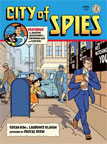 City
of Spies City
of Spies
by Susan Kim, Laurence Klavan,
Pascal Dizin
Ages 12–up
Evelyn’s mother is gone and her
father is too busy to take car of her, so she is sent
to live with her aunt in New York City. It’s 1942 and
Evelyn spends most of her time reading superhero comics
and dreaming of catching a Nazi spy. Tony, the son of
the building superintendent, catches Evelyn’s spy fever
and the two stumble over a real-life Nazi plot. This
graphic novel features art reminiscent of Hergé’s Tintin
and explores themes of friendship, social class, and
abandonment while never losing touch with the scary adventure. |
|
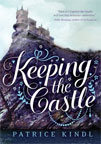 Keeping
the Castle Keeping
the Castle
by Patrice Kindl
Ages 12–up
Althea Crawley (17) must marry
a rich man if she is to keep the family castle from
ruin and support her widowed mother and younger brother.
Unfortunately there aren’t many wealthy bachelors in
the small Yorkshire town of Lesser Hoo. Then Lord Boring
arrives (young, rich, and available) and Althea sets
her plans in motion. The only problem is Lord Boring’s
companion Mr. Fredricks, who always seems to come between
them. Set in the 19th century, this witty novel features
an endearing and ingenious heroine. |
|
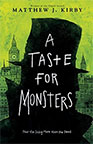 A Taste for Monsters A Taste for Monsters
by Matthew J. Kirby
Ages 12–up
It’s 1888 in London, and Jack the Ripper is terrorizing the city. Evelyn, a young woman disfigured by her dangerous work in a matchstick factory, has been hired as a maid for Joesph Merrick, known as the Elephant Man because of his deformities. Evelyn’s jaw has been destroyed by phosphorus necrosis, and she is happy to hide away in London Hospital with Merrick, once she can see past his deformities to his gentle nature. Merrick is haunted by the ghosts of Jack the Ripper’s victims, and Evelyn ventures from the safety of the hospital to the dangers of the slums to put the ghosts to rest. |
|
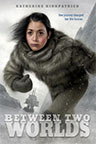 Between Two Worlds Between Two Worlds
by Katherine Kirkpatrick
Ages 14–up
Billy Bah (16) lives in Itta, Greenland, about as far north as you can get. As a child, Billy lived in America with Arctic explorer Robert E. Perry and his family. Back in Greenland and married to another Inuit, Billy spots an American ship bringing supplies for Perry. Billy’s husband begins trading her to an American sailor, a common Inuit practice in 1900, and she finds herself becoming attracted to the American. Rich details of Inuit life provide the background to the story of a young woman caught between cultures. |
|
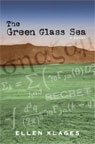 The
Green Glass Sea The
Green Glass Sea
by Ellen Klages
Ages 10–14
It’s 1943 and 10-year-old budding inventor
Dewey Kerrigan sets off with her father to do secret war work
in New Mexico. As the adults work on “the gadget,” the
kids at Los Alamos are often left to their own devices. When
the atomic bomb tests are finally successful, both children
and adults grapple with the ethical implications as they realize
how “the gadget” will be used. The unique atmosphere
of the secretive scientific community is clearly presented
in this excellent historical novel, but the true nature of “the
gadget” may not be understood by kids who don’t know
it already. |
|
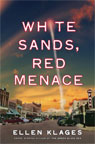 White
Sands, Red Menace White
Sands, Red Menace
by Ellen Klages
Ages 10–14
It’s 1946, and Suze and Dewey are living
near Los Alamos with Suze’s parents who helped build the atom
bomb with Dewey’s late father. Suze’s father is working on
rockets to maintain the US edge over the Soviets while her
mother organizes scientists against the war. This excellent
historical fiction helps middle graders grapple with moral
dilemmas while creating strong characters with realistic emotional
issues. (sequel to The
Green Glass Sea) |
|
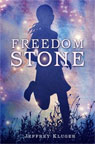 Freedom
Stone Freedom
Stone
by Jeffrey Kluger
Ages 9–12
When the Confederate Army promised
freedom to the family of any slave who served in the
army, whether he made it home or not, Lillie’s father
decided he had to take the chance. But when Lillie’s
father is killed in the war, the army claimed he was
a thief and the plantation master refused to free the
family. In fact, he decided to sell Lillie’s little
brother Plato. With the help of another slave, Lillie
travels to the battlefield to prove her father’s innocence
and win freedom for her family. |
|
 Play
Ball, Jackie! Play
Ball, Jackie!
by Stephen Krensky, Joe Morse
Ages 7–10
It’s 1947, and 10-year-old
Matty Romano is going to his first baseball game with
his father to see the Brooklyn Dodgers, his favorite
team. It’s also the first day for Jackie Robinson,
the first Black baseball player in the major leagues.
The crowd is divided between those who are outraged
and those who just want to see good baseball players,
no matter what their color. Matty’s conversations with
his father provide an intimate look at this historic
baseball game. |
| |
|
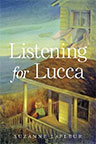 Listening for Lucca Listening for Lucca
by Suzanne LaFleur
Ages 8–12
About two years ago Siena (now 13) began to dream about a house by the sea and war planes crashing. Around the same time, Siena’s little brother Lucca (now 3) stopped talking. Obsessed by visions from the past, Siena grows apart from her friends and begins collecting abandoned objects. Hoping that a change of scene will help both children, their parents move the family from Brooklyn to Maine, moving into a house that has an eerie resemblance to the one from Siena’s dreams. Siena connects to the ghost of a dead girl from the past, whose brother died in WWII. This suspenseful book is an engaging mix of history, mystery, and family life. |
|
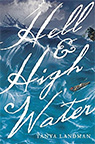 Hell and High Water Hell and High Water
by Tanya Landman
Ages 12–up
Caleb, the dark-skinned son of a white puppeteer, has always helped his father with their Punch and Judy shows until his father is arrested for a theft he didn’t commit and sentenced to be transported to the American colonies. Caleb is sent to live with an aunt he didn’t know he had. She welcomes him, but the other villagers are suspicious of Caleb’s dark skin. A body washes up on shore with an unrecognizable face but wearing Caleb’s father’s ring. Then his uncle returns from sea acting very strangely. Caleb is determined to find the truth despite racism and danger. |
|
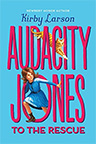 Audacity Jones to the Rescue Audacity Jones to the Rescue
by Kirby Larson
Ages 8–12
Audacity Jones (11) is an orphan living in Miss Maisie’s School for Wayward Girls in Swayzee, Indiana, in 1910. Audie has a pet cat named Minivar, a good friend, and plenty of books to read, but longs for adventure. When Commodore Crutchfield whisks her off to Washington, DC, Minivar slips into the car. Audie isn’t sure she can trust the Commodore, and makes friends with a newsboy named Juice and his grandfather, who works in the White House stables. This clever historical mystery is the first in a planned series. |
|
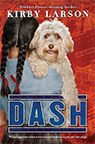 Dash Dash
by Kirby Larson
Ages 8–12
After the Japanese attack on Pearl Harbor life changes for Mitsi Kashino (11) and her Japanese-American family. Mitsi tries to stay strong as she and her family are taunted, shunned, fingerprinted, and told they will be relocated to in interment camp. The news that she cannot take her beloved dog Dash to the camp, Mitsi begs her neighbor, Mrs. Bowker, to take care of Dash. Mrs. Bowker agrees to take care of Dash, and writes letters from Dash to Mitsi that follow the family from Seattle, Washington, to Minidoka, Idaho. |
|
 Duke Duke
by Kirby Larson
Ages 8–12
Hobie Hanson (11) is determined to do everything he can to help the war effort while his father is overseas flying B-24s in WWII. He makes do with less, collects rubber, and buys War Bonds. When his father is taken prisoner, Hobie decides to donate his beloved German Shepherd Duke to Dogs for Defense, which trains dogs to act as act as sentries, mine sniffers, and patrol dogs for the military. Hobie immediately regrets his decision, and does everything he can to get Duke back, even answering letters from Duke’s Marine handler with misinformation. Finally Hobie divulges information that enables Duke and his handler to save lives in battle. |
|
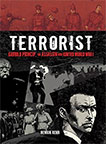 Terrorist: Gavrilo Princip, the Assassin Who Ignited World War I Terrorist: Gavrilo Princip, the Assassin Who Ignited World War I
by Henrik Rehr
Ages 13–up
Little is known about Gavrilo Princip, the young Serbian nationalist who
assassinated Archduke Franz Ferdinand of Austria and set in motion the events leading to World War I. The 9/11 attacks in New York City caused the Henrik Rehr to wonder what drove ordinary people to become terrorists. This gripping graphic novel imagines the details that drove the young man from poverty-stricken Bosnia to contemplate murder as the only possible solution. |
|
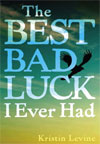 The
Best Bad Luck I Ever Had The
Best Bad Luck I Ever Had
by Kristin Levine
Ages 10–up
It’s 1917 in a small town in
Alabama and 12-year-old Dit has been looking forward
to the arrival of the new postmaster who is said to have
a son his age. But when the new family arrives, the son
turns out to be a girl called Emma. And everyone is surprised
that the new family is “colored.” But Dit
is impressed with Emma’s intelligence and determination
and he begins to reconsider his views about race and
justice. |
|
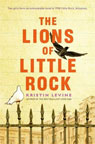 The
Lions of Little Rock The
Lions of Little Rock
by Kristin Levine
Ages 10–up
It’s 1958, the year after the
Little Rock Nine integrated the city’s public high schools,
and Little Rock has closed the high schools rather than
follow the federal mandate to integrate. Twelve-year
old Marlee, who doesn't speak outside her family, has
no friends at school until befriended by Liz, the new
girl. Liz begins to coax Marlee out of her silence and
then suddenly disappears. Rumors fly that Liz was a colored
girl passing for white. Marlee is determined to stay
in touch with the only close friend she ever had, and
struggles to find the courage to speak out. |
|
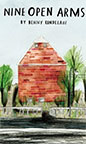 Nine Open Arms Nine Open Arms
by Benny Lindelauf
Ages 9–up
The motherless Boon family are down on their luck when the move to a leaky old house on the edge of a small Dutch town in 1937. Fing (10) and her sisters are sure that the house and the cemetery are haunted by tragedy. Against their grandmother’s orders they explore the dark cellar and venture through the strange hole in the hedge. Their father’s latest get-rich-scheme falls apart as usual, and there is a bully at the new school, but the mystery of their isolated location gives the children plenty to keep their minds off other things. Four older brothers add to the chaos of this engaging family. |
|
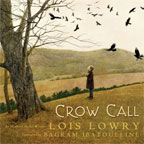 Crow Call Crow Call
by Lois Lowry
Ages 6–12
Lizzie’s father has been away in WWII
for longer than she can remember, so the fall hunting trip
the two take together after his return is awkward. But her
father respects her wishes, even when they are fanciful, and
gives her the crow call to summon the birds. To Lizzie’s relief,
her father never fires his gun on the magical day. Based on
Lowry’s own childhood, this picture book is a loving look at
the relationship between parent and child. Though set in the
past, it is fully relevant to today’s military families. |
|
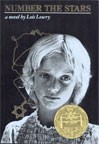 Number
the Stars Number
the Stars
by Lois Lowry
Newbery Medal 1990
Ages 10–up
It’s 1943 in Nazi-occupied Denmark, and
the Jews are about to be rounded up and sent to the death camps.
Annemarie Johannesen’s best friend Ellen Rosen is Jewish. The
Johannesen family helps Ellen’s parents go into hiding and take
Ellen into their own home, pretending she is part of their family.
Narrated by 10-year-old Annemarie, this book vividly portrays
the Nazi threat and the courage it takes to help friends while
possibly endangering your own family. This moving and suspenseful
book is based on true events. |
|
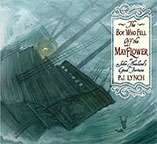 The Boy Who Fell Off the Mayflower, or John Howland’s Good Fortune The Boy Who Fell Off the Mayflower, or John Howland’s Good Fortune
by P.J. Lynch
Ages 7–10
Based on historical facts, this accessible account of the voyage of the Mayflower and the first year of the Pilgrims in America is narrated by real-life indentured servant John Howland. Beginning in 1620s London, John tells the story of his fall overboard during a storm and his early experiences in the new world. The detailed illustrations are stunning. |
|
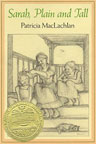 Sarah,
Plain and Tall Sarah,
Plain and Tall
by Patricia Maclachlan
Newbery Medal 1986
Ages 8–12
In the late 19th century, a widowed
midwestern farmer with two children, Anna and Caleb, advertises
for a wife. Sarah responds, saying that she is plain and tall.
When Sarah arrives she is homesick for Maine, and especially
for her beloved ocean. The children fear she will not stay. Narrated
by Anna, this short book gently explores abandonment, loss, and
love. |
|
 Egg and Spoon Egg and Spoon
by Gregory Maguire
Ages 12–up
Elena Rudina lives in the Russian countryside with her dying mother in a tiny hut with very little food. Her father has been dead for years, one of her brothers was conscripted into the Tsar’s army, and her other brother has been taken as a servant by the local landowner. A train arrives carrying a wealthy family on a visit to the Tsar in Saint Petersburg. When the train is stranded by a broken bridge, Elena begs for food, and meets Ekaterina, a girl of her own age. The two girls begin a tentative friendship, and when the train departs, the wrong girl is aboard. This masterful tale includes elements from Russian folklore, Cinderella, and The Prince and the Pauper. |
|
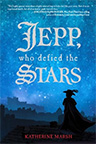 Jepp, Who Defied the Stars Jepp, Who Defied the Stars
by Katherine Marsh
Ages 12–up
Jepp (15) is a dwarf living at the end of the 16th century. While caged and transported, Jepp looks back on his childhood at a humble inn and his life as a court dwarf at Coudenberg Palace, the royal court of the Spanish Infanta in Brussels. From that luxurious prison, Jepp finally arrives at the island castle of the astronomer Tycho Brahe. Inspired by an actual dwarf who served Brahe, this novel explores love, family, and making one’s own destiny. |
|
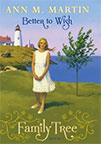 Better to Wish Better to Wish
by Ann M. Martin
Ages 8–12
Abby Nichols (8) is the oldest daughter of a carpenter determined to give his family a better life in 1930s Maine. Due to her father’s hard work, the family prospers, moving into a bigger house in the city. But Abby is disturbed by her father’s mistreatment of her mentally impaired baby brother and his orders that she is not to play with her Irish Catholic neighbors. The powerlessness of women and children during this time period is deftly portrayed. |
|
 A Beautiful Lie A Beautiful Lie
by Irfan Master
Ages 13–up
It’s 1947 in India, and Bilal (13) is determined to protect his dying father’s peace of mind by concealing the imminent Partition and creation of Pakistan, which will divide the country along religious lines, separating Muslims like Bilal’s family from the predominantly Hindu population. With the help of his friends, Bilal builds an elaborate deception, even printing false pages of the local newspaper to hide the truth from his father, a staunch supporter of a united India. This intense and fascinating novel deals with themes of love, loss, religious intolerance, and the wisdom of hiding the truth. |
|
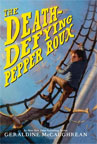 The
Death-Defying Pepper Roux The
Death-Defying Pepper Roux
by Geraldine McCaughrean
Ages 10–up
Pepper Roux’s death by age 14
was foretold in a dream, and his aunt Mireille has prayed
over him everyday. When Pepper wakes up on the morning
of his 14th birthday, he is amazed to find himself still
alive, and runs off to sea hoping to escape death a bit
longer. Pepper then flees across the French countryside
from one disastrous job to another until the totally
satisfying climax. |
|
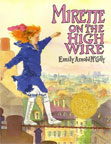 Mirette
on the High Wire Mirette
on the High Wire
by Emily Arnold McCully
Caldecott Medal 1993
Ages 4–8
Mirette helps “The Great Bellini” regain
his confidence while he stays at her mother’s boarding house
and eventually the two are walking the high wire above the rooftops
of the city. Rich illustrations capture 19th-century Paris. |
|
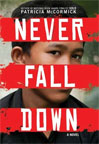 Never
Fall Down Never
Fall Down
by Patricia McCormick
Ages 14–up
When the Khmer Rouge soldiers
march into his village in Cambodia, Arn Chorn Pond is
only 11, busy selling ice cream with his brother and
dancing to rock and roll. The Communist revolution changes
his life forever. Sent to a labor camp, Arn learns to
be invisible, hiding from the soldiers who dispense death
at a whim. Then one day the soldiers ask if any of the
children can play an instrument, and Arn learns to play
the revolutionary songs the soldiers demand, earning
enough food to keep himself and the other children alive.
This powerful true story doesn’t hide the brutality of
the Khmer Rouge, yet celebrates the power of the human
spirit. |
|
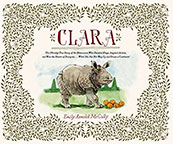 Clara: The (Mostly) True Story of the Rhinoceros who Dazzled Kings, Inspired Artists, and Won the Hearts of Everyone… While She Ate Her Way Up and Down a Continent Clara: The (Mostly) True Story of the Rhinoceros who Dazzled Kings, Inspired Artists, and Won the Hearts of Everyone… While She Ate Her Way Up and Down a Continent
by Emily Arnold McCully
Ages 4–8
In 1741 Captain Douwemont Van der Meer transported a young rhinoceros he named Clara from India to his home in Leiden, Holland. Europeans had never seen a rhinoceros, and Van der Meer took Clara to Berlin, Rome, Paris, Vienna, and other cities where she amazed peasants and aristocrats alike. Poets, artists, and musicians created works in her honor, while Van der Meer struggled to raise enough money to keep Clara fed. She consumed 100 pounds of hay and 30 loaves of bread a day, and had a great fondness for oranges and beer. Every day Clara grows in size, necessitating ever larger wagons for transportation. Watercolor illustrations capture the affection between Clara and Van der Meer and the fashions of the time. |
|
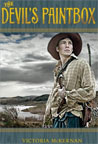 The
Devil’s Paintbox The
Devil’s Paintbox
by Victoria McKernan
Ages 12–up
It’s 1865 and Aiden (16) and
his younger sister Maddie are nearly starving on their
late parent’s farm in Kansas. The guide of a wagon
train heading west offers free passage to Aiden and
Maddie in return for their labor at a logging camp
at journey’s end. While traveling across the country,
Aiden works through his despair and begins to hope
again. The strong characters and honest look at our
sometimes brutal history will keep teen readers glued
to the pages. |
|
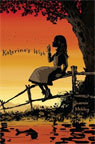 Katerina’s
Wish Katerina’s
Wish
by Jeannie Mobley
Ages 8–12
Katerina (13) and her father
are both dreamers. It was her father’ s dream of owning
their own farm that brought the family from Bohemia
to Colorado in 1900. But it’s been a year now and Papa
is still working in the dangerous coal mine that was
supposed to be a temporary solution to earn enough
money to buy the farm. Then Trina sees a fish that
reminds her of the magical wish-granting carp from
an old fairy tale. When her two younger sisters’ frivolous
wishes are granted, Trina wishes for the farm that
will make her family happy and secure. Themes of optimism
versus realism, magic versus hard work, and xenophobia
versus neighborliness make this debut novel stand out. |
|
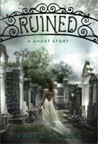 Ruined Ruined
by Paula Morris
Ages 12–up
Rebecca Brown (15) is sent from New
York City to live with her aunt in New Orleans while her father
travels overseas for a year. Rebecca feels out of place at
the snooty prep school. In fact, to the rich girls she is nearly
invisible. Rebecca befriends Lisette, a ghost who has haunted
the cemetery since her mysterious death 155 years earlier.
This atmospheric ghost story captures the rich history of New
Orleans, and doesn't shy away from issues of race, ethnicity,
class, and culture. |
|
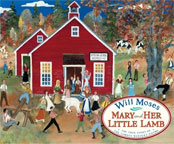 Mary
and Her Little Lamb Mary
and Her Little Lamb
by Will Moses
Ages 1–5
Mary Elizabeth Sawyer was a
real little girl who lived on a farm in 19th century
Massachusetts. When Mary nursed a newborn lamb back
to health, the lamb accepted Mary as its mother and
followed her everywhere, even to school one day. John
Roulstone was at school that day, and wrote the famous
nursery rhyme about Mary who had a little lamb. Beautiful
full page paintings, by the great-grandson of Grandma
Moses, illustrate the simple story. |
|
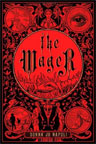 The
Wager The
Wager
by Donna Jo Napoli
Ages 12–up
Set in 1169, this novel tells
the story of Don Giovanni, a wealthy 19-year-old orphan
who suddenly loses his riches and his castle in a tidal
wave and is reduced to begging for food to survive.
The devil appears to offer a wager—if Don Giovanni
agrees not to bathe or change his clothes for three
years, three months, and three days, he will receive
a purse that magically refills. Giovanni’s descent
into foul decay and eventual redemption is colorfully
portrayed in this retelling of a traditional Italian
fairy tale. |
|
 Our
White House: Looking In, Looking Out Our
White House: Looking In, Looking Out
by National Children’s Book and
Literary Alliance
Ages 10–up
An all-star roster of 108 children’s
authors and illustrators plus scholars and former White
House employees and residents combine to make up this multifaceted
view of the White House from the inside as well as the
outside, a personal and ongoing history from 1792 to the
present. |
|
 Auma’s Long Run Auma’s Long Run
by Eucabeth Odhiambo
Ages 8–up
Auma (13) loves to run, and hopes to win a track scholarship so that she can go to high school and eventually become a doctor. But then a strange new sickness arrives in her small Kenyan village, her father falls ill, and her family needs her help at home. Auma has to choose between leaving her family to go to school, or quitting school to get a job to support her family. |
|
 The Boundless The Boundless
by Kenneth Oppel, Jim Tierney
Ages 8–12
James Everett was just another railroad worker laying track for the Canadian Pacific Railway until the day he saved the railroad’s president from an avalanche in 1885. Three years later James is a railroad executive traveling with his son Will on the first journey of the Boundless, the largest train ever assembled. Among the 947 cars is a circus, and Will befriends Maren, a beautiful high wire walker. Will learns that a plot is afoot to steal treasure, including the golden spike, from the vault-like mausoleum car. This action adventure is set in a slightly alternative reality, where sasquatches roam the northern forests. |
|
 A
Long Walk to Water A
Long Walk to Water
by Linda Sue Park
Ages 10–up
Based on a true story, this
moving novel tells the story one of the “lost
boys” from Sudan. In 1956, when Salva is 11,
his school is attacked by brutal rebel solders. Covering
the next 23 years of his life, Salva's narration tells
of hunger, death, refugee camps, and his eventual relocation
to New York. Interspersed with Salva’s narrative is
that of Nya, who tells of her life in modern (2008)
Sudan, which revolves around her daily eight hour walk
to fetch water for her family. The two stories meet
when Salva returns to Sudan to help his people and
builds a well in Nya’s village. This honest book presents
harsh realities in terrifying detail, yet ends on a
note of hope for a better future. |
|
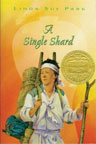 A
Single Shard A
Single Shard
by Linda Sue Park
Newbery Medal 2002
Ages 10–14
In a potter’s village in 12th century
Korea, the orphan Tree Ear is raised by a lame straw weaver.
One day Tree Ear breaks a piece of Min’s pottery and pays his
debt by working for the potter and dreaming of making beautiful
pots himself. Tree Ear is sent by Min to the king’s court, carrying
an example of Min’s new celadon ware. After robbers shatter the
pot, Tree Ear continues the dangerous journey, now carrying only
one precious single shard. |
|
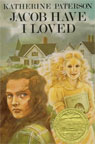 Jacob
Have I Loved Jacob
Have I Loved
by Katherine Paterson
Newbery Medal 1981
Ages 12–up
Growing up on Chesapeake Bay island in
the early 1940s, Louise knows that like Esau from the Bible she
is hated while her twin sister Caroline, like Jacob, is the one
everyone loves. While the family pampers the beautiful and gifted
Caroline, lonely and miserable Louise learns the way of the watermen
from old Captain Wallace. Eventually Louise learns that she has
her own strengths. |
|
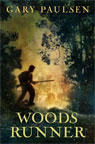 Woods
Runner Woods
Runner
by Gary Paulsen
Ages 12–up
Sam (13) is a skilled hunter,
a “woods runner” with an instinctive knowledge
of the western Pennsylvania forest. When word of the
fighting between the British and the American colonists
reaches the family, they worry that their safe world
is endangered. One day Sam returns from hunting to find
the houses in their settlement burned to the ground and
the scalped bodies of neighbors. Sam sets off on a harrowing
quest to find and rescue his parents, taken prisoner
by British soldiers aided by Iroquois. Interspersed historical
sections help place Sam’s struggle in context. |
|
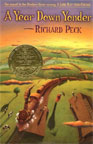 A
Year Down Yonder A
Year Down Yonder
by Richard Peck
Newbery Medal 2001
Ages 10–up
It’s 1937 and Mary Alice (15) is banished
from Chicago to spend a year with Grandma Dowdel in rural Illinois
while her parents struggle to make ends meet and her brother
Joey heads west with the Civilian Conservation Corps. Mary Alice
knows it won’t be easy being the new city kid in a country school,
especially with an outrageous relative like Grandma. This hilarious
and touching book is the sequel to A
Long Way to Chicago. |
|
 Isabel’s War Isabel’s War
by Lila Perl
Ages 8–12
Isabel Brandt (12) lives in 1942 New York City. Like most girls her age, the war in Europe seems very far away. Then Helga, a refugee from Germany arrives. At first jealous and resentful of the beautiful stranger, Isabel is horrified when she learns of Helga’s horrific experiences in Germany before being transported to England as part of the Kindertransport. Learning the truth about the treatment of Jews by Nazis changes Isabel, and she begins to try to help Helga come to terms with her guilt for escaping and leaving her family behind. |
|
 The
Mostly True Adventures of Homer P. Figg The
Mostly True Adventures of Homer P. Figg
by Rodman Philbrick
Ages 9–12
When Uncle Squinton sells off
Homer P. Figg’s older brother Harold to take the place
of a rich man’s son in the Union army, Homer sets off
to rescue him. Told in the form of a rip-roaring yarn,
Homer’s adventures are exciting and funny, but the
horror of war and injustice of slavery aren’t ignored.
(2010 Newbery Honor Book) |
|
 January’s
Sparrow January’s
Sparrow
by Patricia Polacco
Ages 8–12
The Crosswhite family witness
the brutal whipping of January, a slave caught while
trying to escape, and flee the Kentucky plantation
in the middle of the night. Young Sadie is heartbroken
when she realizes she has left the wooden sparrow January
carved for her, her only memento of her dead friend.
The Crosswhites travel through the Underground Railroad
to Marshall, Michigan, where they finally live in freedom.
Then January’s sparrow appears on their doorstep. Based
on a true story, this book is both horrifying and empowering. |
|
 Heart
of a Samurai Heart
of a Samurai
by Margi Preus
Ages 10–14
In 1841, Japan is closed to
outsiders, and Japanese leaving the country are not
permitted to return. Manjiro Nakahama (14) is out fishing
with four others when a storm destroys their small
boat and strands them on a small island. Rescued five
months later by an American whaling ship. Manjiro’s
companions are frightened of the “barbarians,” but
he is curious to learn more about the world. Adopted
by the captain, Manjiro learns English and the whaling
trade, and eventually becomes the first Japanese to
come to America. Despite prejudice, hardships, and
homesickness, Manjiro never loses his curiosity. After
living in New England, Manjiro travels to California
to pan for gold, and eventually makes his way back
to Japan, where he is imprisoned as an outsider. Period
illustrations by Manjiro himself, as well as new art
by Jillian Tamaki, enliven this fictionalized true
story. |
|
 Sovay Sovay
by Celia Rees
Ages 12–up
Raised in the English countryside during
the French Revolution, 17-year-old Sovay sets out to find her
father and brother who have been condemned for supporting the
Revolution. Playing the roles of highway robber, spy, and socialite,
Sovay travels from London to Paris in this romantic and suspenseful
story of political intrigue and class struggle. |
|
Terrorist: Gavrilo Princip, the Assassin Who Ignited World War I
by Henrik Rehr
Ages 13–up
Little is known about Gavrilo Princip, the young Serbian nationalist who
assassinated Archduke Franz Ferdinand of Austria and set in motion the events leading to World War I. The 9/11 attacks in New York City caused the Henrik Rehr to wonder what drove ordinary people to become terrorists. This gripping graphic novel imagines the details that drove the young man from poverty-stricken Bosnia to contemplate murder as the only possible solution. |
|
 The
Summer I Learned to Fly The
Summer I Learned to Fly
by Dana Reinhardt
Ages 12–up
Drew (13) is a bit of a loner.
She has a pet rat, a treasured book of lists from her
dead father, and an encyclopedic knowledge of cheese
from working at her mother’s gourmet cheese shop. Drew
meets a strange boy named Emmett in the alley behind
the shop while searching for her escaped pet. Emmett
surprises Drew with his knowledge of rats and the two
become friends. Emmett confides his dream of finding
a legendary spring with healing powers, and Drew betrays
her mother’s trust by running away with Emmett in search
of the magic waters. Set in California in the 1980s,
this quiet novel touches on themes of friendship, love,
and sacrifice. |
|
 Back
of the Bus Back
of the Bus
by Aaron Reynolds, Floyd Cooper
Ages 6–8
One winter day in Montgomery
Alabama, a young boy and his mother are riding where
they are supposed to—in the back of the bus.
The boy passes the time rolling his marble in the aisle,
and Rosa Parks, sitting up in the front of the bus
where she isn’t supposed to, rolls it back to him.
See through the eyes of a child, who begins to wonder
if maybe Rosa does belong up there after all, brings
Rosa Park’ s defiance to vivid life. Beautifully lifelike
oil paintings convey the emotional tension of that
famous bus ride. |
|
 May
B. May
B.
by Caroline Starr Rose
Ages 8–12
May B. (12) lives with her
family on the Kansas prairie. After a bad harvest,
May B. is sent to a farm 15 miles away to help out
the farmer and his new wife. Her father promises that
it’s only until Christmas, but May B. misses her family
and the opportunity to attend school. Then the homesick
farmer’s wife runs off to her Ohio home, followed by
the farmer, leaving May B. alone on the farm. Alone
in the sod house, May B. bravely faces bad weather
and dwindling supplies. |
|
 Someday
Dancer Someday
Dancer
by Sarah Rubin
Ages 12–up
Casey Quinn is a farm girl in rural
1959 South Carolina. Casey is sure she was born to dance,
but her parents can’t afford ballet lessons. Encouraged by
her grandmother to follow her dream, Casey makes her way
to the open auditions of the American School of Ballet in
New York City. Casey is eliminated in the first round, but
choreographer George Balanchine sends her to Martha Graham’s
audition, where Casey falls in love with modern dance. Accepted
into the scholarship program, Casey must balance the demands
of family, friendship, and school. |
|
 Irena
Sendler and the Children of the Warsaw Ghetto Irena
Sendler and the Children of the Warsaw Ghetto
by Susan Goldman Rubin, Bill Farnsworth
Ages 8–12
Though small in stature, Irena
Sendler, a Polish social worker, managed to smuggle
more than 400 Jewish children out of the Warsaw ghetto
during World War II. Using clever ruses like toolboxes,
ambulances, and coffins, Irena defied the Nazis and
risked her own life to bring the children to safety.
Worried that the children might not be reunited with
their families, Irena kept a secret list of the children's
identities buried in jars under a tree in war-torn
Warsaw. Dramatic paintings illustrate this story of
courage and compassion. |
|
 Rooftoppers Rooftoppers
by Katherine Rundell, Terry Fan
Ages 8–12
After a ship sinks, a baby girl is found floating in a cello case, wrapped in the score of a symphony. Charles Maxwell, a young fellow passenger, saves the baby and decides to keep her, despite social pressure of 1890s London to give her up. When Sophie is 12, the authorities order that she be given to an orphanage, so Charles and Sophie flee to Paris, where the cello case was made. Sophie is convince that her mother is still alive, and sets off to search Paris with her new friend Matteo, a street child who lives on the rooftops. |
|
 I
Will Come Back for You: A Family in Hiding During World War
II I
Will Come Back for You: A Family in Hiding During World War
II
by Marisabina Russo
Ages 5–9
A small girl wonders why her
grandmother always wears a bracelet with curious charms
on it, and eventually Nonna tells the story of her
childhood in Rome during World War II. When the Nazis
threatened the Jews, Nonna was separated from her father
and sent to hide in the mountains with her mother and
brother. Each of the seven charms represents one of
the months the family was separated, and there is a
story of fear, ingenuity, and compassion to go with
each one. Based on her own family history, Russo tells
the tale of this terrifying time in a reassuring way
that is appropriate for young children. |
|
 The
Dreamer The
Dreamer
by Pam Muñoz Ryan, Peter Sís
Ages 9–14
This fictionalized story of
Pablo Neruda’s early life in the small town of Temuco,
Chile presents a shy child curious about the wonders
of nature. Young Neftalí Reyes (Neruda’s real
name) admires his uncle who owns the local newspaper,
but the boy’s father has no patience for Neftalí’s
daydreaming and love of reading and writing. The poetic
text captures the spirit of an artist who savors the
sound of words and the importance of dreaming in the
development of a poet. |
|
 The Blackthorn Key The Blackthorn Key
by Kevin Sands
Ages 10–14
Life is hard for orphans in the 1600s in London, and Christopher Rowe (14) is lucky to be apprenticed to Master Benedict Blackthorn, a kind apothecary. But someone is murdering apothecaries, and Master Blackthorn is attacked. Christopher flees, and with his friend Tom uses all the scientific skills he has learned to rescue his master and find the killers. |
|
 Anna and the Swallow Man Anna and the Swallow Man
by Gavriel Savit
Ages 12–up
In 1939 Kraków, Anna (7) is left in the care of Herr Doktor Fuchsmann, a neighborhood pharmacist for a few hours while her father, a linguistics professor, is summoned to a meeting with the Gestapo. None of the university professors return from the meeting, and Herr Doktor Fuchsmann is too nervous to allow Anna to stay. Cast into the streets, Anna follows the strange tall man who talks to the birds. The Swallow Man teaches Anna how to survive in the hostile landscape that was her home, sometimes challenging her instincts for honesty and compassion. |
|
 The War within These Walls The War within These Walls
by Aline Sax, Caryl Strzelecki
Ages 14–up
Misha, a Jewish teenager in 1940 Warsaw, is walled into a section of the city by the Nazis. Misha fights against the overcrowding and inhumane conditions of the ghetto by smuggling food until his younger sister disappears during a trek through the sewer system. When he learns that the Nazis plan to kill all the Jews by transporting them to concentration camps, he joins a rebel group led by Mordechai Anielewicz, determined to fight back no matter how hopeless their cause might be. Somber blue-and-white illustrations and spare prose tell the nightmarish story. |
|
 Good
Masters! Sweet Ladies! Good
Masters! Sweet Ladies!
Voices
from a Medieval Village
by Laura Amy Schlitz
Newbery Medal 2008
Ages 10–up
Written to be performed by a classroom
of students, these 23 short monologues in prose and verse bring
to life an English village in 1255. |
|
 The Hired Girl The Hired Girl
by Laura Amy Schlitz
Ages 12–up
Joan Skraggs (14) works hard on her family’s farm in Pennsylvania. Joan loves to read and longs for more education, but her father refuses. Joan pours her longing out for a better life in her diary. When her father burns her books, Joan runs away to Baltimore, hoping that she can get a job as a hired girl, cooking and cleaning for six dollars a week. She is hired by a wealthy Jewish family, amazed by their unity as a close loving family unit. Joan learns about keeping kosher and is exposed to art, music, and literature. She grows to love the family, and is shocked when she encounters anti-Semitism. Joan’s journey to adulthood is inspiring, and modern readers will be horrified by the amount of work required to cook and clean in the early 20th century. |
|
 Looking for Jack Kerouac Looking for Jack Kerouac
by Barbara Shoup
Ages 14–up
In 1964, Paul Carpetti discovers Jack Kerouac’s On the Road and begins to question the direction of his own future. When Paul’s mother dies suddenly, his friend Duke convinces him to take a road trip to Florida in search of Kerouac, rumored to be living in St. Petersburg. On the journey the two confront changes in music, politics, race relations, and attitudes toward the Vietnam War in this sensitive coming-of-age story. |
|
 Revolver Revolver
by Marcus Sedgwick
Ages 12–up
It’s 1910 in the Scandinavian town
of Giron, 100 miles north of the Arctic Circle. Fourteen-year-old
Sig has just seen his father die after a fall through the ice
when a stranger appears, demanding the gold he says Sig’s father
stole from him 10 years earlier during the Alaskan Gold Rush.
Sig’s only protection is is father’s Colt revolver hidden in
the storeroom of the isolated cabin. The truth is slowly revealed
as Sig struggles to decide if he will use the gun. |
|
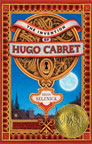 The
Invention of Hugo Cabret The
Invention of Hugo Cabret
by Brian Selznick
Caldecott Medal
2008
Ages 9–12
Hugo, a 12-year-old-orphan lives in the
walls of a Paris train station at the turn of the 20th century,
trying to finish an invention his father left. Black and white
pencil illustrations pay homage to flickering silent movies. |
|
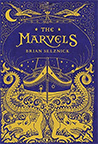 The Marvels The Marvels
by Brian Selznick
Ages 8–12
This amazingly inventive book imagines the life of the family who lived in the real Dennis Severs House in London. The first part of the story is told entirely in pictures that span nearly 400 pages, beginning with Billy Marvel, a boy who survives a shipwreck in 1766 and finds work in a London theatre. The family flourishes as actors until 1900, when young Leontes Marvel is banished from the stage. The story continues in 200 pages of prose. Nearly a century later, Joseph Jervis runs away from home and takes refuge with his uncle Albert Nightingale in his strange and beautiful house, leading Joseph into a quest to learn about the history of the house and his family. |
|
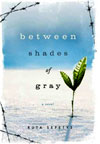 Between
Shades of Gray Between
Shades of Gray
by Ruta Sepetys
Ages 12–up
Lina is a normal 15-year old
girl who loves to draw and paint and dream about boys
until the night in 1941 when Soviet soldiers invade
her town. Separated from her father on a crowded train,
Lina is sent to a work camp with her mother and younger
brother. The three make a long and arduous journey
north to the Siberian work camp north of the Arctic
Circle, where they are forced to dig for beets as they
struggle to survive. Using her art to maintain her
sense of hope, Lina illustrates messages she hopes
will reach her father in prison. Based on historical
fact, this gripping novel illustrates the persecution
suffered by the millions of Stalin’s victims. |
|
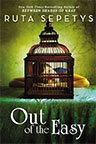 Out of The Easy Out of The Easy
by Ruta Sepetys
Ages 14–up
Josie Moraine, the daughter of a brothel prostitute in the French Quarter in 1950s New Orleans, dreams of escaping from her life and attending college. Josie works in a local bookstore in exchange for a safe place to sleep and cleans the brothel to earn money for college. When Josie becomes involved in a murder investigation and a mob debt, escaping her circumstances becomes more unlikely than ever, but Josie is determined to be in charge of her own destiny. |
|
 Salt to the Sea Salt to the Sea
by Ruta Sepetys
Ages 12–up
World War II is ending in East Prussia, and thousands of refugees are desperately fleeing the country, many with secrets to hide. Four narrative voices describe the plight of the refugees who end up on the Wilhelm Gustloff, a ship they hope will take them safely to freedom. Florian is a Prussian boy carrying a secret parcel, Amelis is a 15-year old pregnant Polish girl with no papers, Joana is a 21-year-old Lithuanian nurse who is convinced she is guilty of murder, and Alfret is a German solder aboard the Wilhelm Gustloff, a doomed ship whose causalities will exceed those of the Titanic and Lusitania combined. |
|
 The
Berlin Boxing Club The
Berlin Boxing Club
by Robert Sharenow
Ages 12–up
Karl Stern (14) has never thought
of himself as Jewish since his family isn’t religious.
But in 1930s Berlin he is tormented and beaten by his
classmates so his father’s friend Max Schmeling, a
boxing champ, agrees to train Karl as a boxer so he
can defend himself and his younger sister. As the Nazi
regime gains power, it becomes clear that Karl and
his family aren’t safe in German. A talented artist,
Karl draws cartoons and comics as he dreams of finding
freedom in America, falls in love with a Catholic neighbor,
and meets a cross-dressing homosexual. This powerful
historical novel examines racism and prejudice through
the lens of both fictional children and real historical
figures. |
|
 I’ll
Pass For Your Comrade: I’ll
Pass For Your Comrade:
Women
Soldiers in the Civil War
by Anita Silvey
Ages 10–14
This non-fiction book tells the
fascinating story of the women who risked their lives and
reputations to fight in the Civil War. Vintage photographs,
etchings, and memoirs illuminate the adventures and struggles
of the women who cut their hair and disguised themselves
as men to join the fight. Highly accessible language helps
to put these unconventional women in historic context. |
|
 Stitches Stitches
by David Small
Ages 12–up
In this memoir, David Small tells the
story of his boyhood in the 1950s. Believing that science can
fix everything, his radiologist father subjected David to numerous
x-rays for various childhood ailments, resulting in cancer
that was untreated for years. At age 14, unaware that he had
throat cancer and was expected to die, David awoke from an
operation left him nearly mute. Beautifully told from a child’s
perspective, this pen and ink graphic novel is both dark and
delightful. |
|
 The Boy on the Bridge The Boy on the Bridge
by Natalie Standiford
Ages 14–up
Laura (19) is an American studying in early 1980s Leningrad. Homesick, cold, and tired of inedible food, Laura is ready to give up until a young Russian artist rescues her from two aggressive gypsy women on a bridge. Laura is immediately attracted to Alyosha, but has been warned not to get involved with Russian men, who probably have ulterior motives for striking up a friendship with Americans. The desperation Laura sees among Alyosha and his friends gives her a new understanding of life behind the Iron Curtain. |
|
 The
Romeo And Juliet Code The
Romeo And Juliet Code
by Phoebe Stone
Ages 8–12
In the middle of WWII, eleven-year-old
Felicity’s parents send her from the dangers of England
to the safety of her father’s family in Maine. When
her Uncle Gideon begins to receive mysterious letters
in her father’s handwriting from Portugal, Felicity
and her new friend Captain Derek set out to crack the
code of the letters and figure out what is being hidden
from her. Themes of culture shock, adaptation, and
perseverance are explored in this romantic mystery. |
|
 Heroes
of the Valley Heroes
of the Valley
by Jonathan Stroud
Ages 10–up
Halli Sveinsson isn’t handsome
or tall or blonde like his siblings. He’s short and
dark and loves playing practical jokes. When one of
his jokes back-fires, Halli is forced to set out on
a quest where he encounters robbers and monsters and
a girl who may have as quick a mind as his own. This
coming-of-age-novel is a surprising look at what bravery
really is. |
|
 The
Brothers Story The
Brothers Story
by Katherine Sturtevant
Ages 14–up
Twins Kit and Christy grow up
in poverty in an Essex village. Christy is “simple” and
dependant upon his brother. The hardships of the Great
Frost of 1683–84 are too much for the teenaged Kit to
bear, and he abandons his brother and flees to London,
where he finds work as an apprentice to a struggling
artist. Kit struggles with issues of familial responsibility,
religion, class, and gender roles in this frank coming-of-age
novel. |
|
 Doom
Machine Doom
Machine
by Mark Teague
Ages 9–12
It’s 1956 and young Jack Creedle
and his disreputable Uncle Bud are trying to fix a
dead car which stranded scientist Dr. Shumway and her
daughter, Isadora, in the small town of Vern Hollow.
When the aliens land, Bud knows they are there to steal
one of his inventions, but everyone else is amazed
when the aliens kidnap seven people and take them off
to the planet Skreepia. This lively illustrated interstellar
adventure will captivate middle school readers. |
|
 Highway
Robbery Highway
Robbery
by Kate Thompson, Robert Dress
Ages 10–up
A young beggar recalls the night
a stranger rode into town, promising the boy a gold coin
if he watched his horse. The boy’s loyalty is tested
by people passing by who offer riches in exchange for
the noble steed. Finally the king’s men arrive and declare
that the horse is Black Bess who belongs to the infamous
highwayman Dick Turpin. The boy now has a moral dilemma
since keeping his word and staying with the horse may
lead to Turpin’s arrest. |
|
 Otto:
The Autobiography of a Teddy Bear Otto:
The Autobiography of a Teddy Bear
by Tomi Ungerer
Ages 8–up
Otto the teddy bear belongs
to David, a Jewish boy living in German. When David
and his family are taken away to the camps, he gives
Otto to his best friend Oskar. Oskar’s father soon
leaves for the front, and Oskar loses Otto in the bombing
raids. Otto is found by an American soldier, and stops
the bleeding that would have killed him. Years later,
Oskar finds Otto in an American antique store, and
their picture in the paper leads to a reunion with
David. Narrated by Otto in a calm voice, this moving
book presents the reality of war, loss, and abandonment. |
|
 Queen
of the Falls Queen
of the Falls
by Chris Van Allsburg
Ages 6–9
Annie Edson Taylor, a 62-year-old
widow, decided she needed a way to strike it rich after
closing her Michigan charm school. In 1901 she read
an article about the popular tourist attraction Niagara
Falls, and decided to become a popular attraction herself.
She commissioned a barrel large enough to hold herself
and a layer of soft pillows, hired a publicist, notified
the press, and launched herself over the falls. Sepia-tinted
illustrations accompany this story of a courageous
woman determined to earn fame and fortune. |
|
 Moon
Over Manifest Moon
Over Manifest
by Clare Vanderpool
Newbery Medal 2011
Ages 9–12
In 1936, while her father is away on
a railroad job, 12-year-old Abeline Tucker spends the summer
in her father’s hometown of Manifest, Kansas. Based on her father’s
stories, Abeline expects something magical, and is disappointed
to find only a worn out old town. But Abeline is determined to
find out what her father was like at her age, and explores the
past through stories and newspaper columns. When she finds a
hidden cigar box full of old letters, Abeline and her new friends
are quickly involved in a spy hunt, eager to unveil the secrets
of the past. |
|
 Navigating Early Navigating Early
by Clare Vanderpool
Ages 9–12
Before Jack’s mother dies at the end of World War II she tells him to keep looking for the things that connect us all, the ways our paths cross, the places our hearts collide. Jack (13) is sent from his Kansas home to a boarding school in Maine where he meets an eccentric student named Early Auden. Early is obsessed with the mathematical concept of pi, believing that Pi is a boy endangered on an epic journey. Jack agrees to accompany Early on his quest to rescue Pi, and the two set off into the wilderness. This intricately plotted story is spellbinding. |
|
 Climbing
the Stairs Climbing
the Stairs
by Padma Venkatraman
Ages 12–up
Set in World War II India, 15-year-old
Vidya’s father joins the freedom fighters who follow
Gandhi’s nonviolent protest of British rule. During a
rally he is severely beaten and left too brain-damaged
to support his family, who must move in with relatives
and work as servants. This novel movingly presents a
unique time and place and shows how love and hope can
blossom in even the most dismal of circumstances. |
|
 The Forbidden Orchid The Forbidden Orchid
by Sharon Biggs Waller
Ages 12–up
Elodie Buchanan is the eldest of 10 sisters living in a small English town in 1861. The girls barely know their father, a plant hunter who travels the world searching for rare plants for his customers. When he fails to locate a rare orchid in China, he is threatened with debtor’s prison. Elodie persuades her father to try once more to find the orchid, and makes the journey back to China with him. Elodie has never ventured out of her small village, and is at first consumed with fear of the unknown. A growing sense of excitement about the world cause her to doubt her ability to return and resume her sheltered life as a respectable and responsible young lady. |
|
 Like Water on Stone Like Water on Stone
by Dana Walrath
Ages 14–up
Shahen Donabedian dreams of going to New York while his twin sister Sosi is perfectly happy with their life in 1914 Anatolia, in the Armenian Highlands, living peacefully as Christians among the Muslims. Then the Ottoman pashas begin to eliminate all Armenians, and their parents are killed in the attack. Shahen and Sosi flee into the mountains with their little sister Mariam, watched over by an eagle. Four sections span a five year period, telling the story of the atrocities of the Armenian genocide in multiple perspective first person verse narratives. |
|
 Black Dove, White Raven Black Dove, White Raven
by Elizabeth Wein
Ages 12–up
Delia and Rhoda are stunt pilots, touring the American countryside in the 1920s, each with a child. When Delia is killed in an airshow, Rhoda decides it is time to fulfill Delia’s dream of raising her son Teo, whose father was Ethiopian, somewhere he won’t be discriminated against because of his skin color. Along with her daughter Emilia, Rhoda moves the family to an Ethiopian coffee plantation just as Haile Selassie takes power and Mussolini prepares an invasion. |
|
 Code
Name Verity Code
Name Verity
by Elizabeth Wein
Ages 14–up
When a British spy plane crashes
in Nazi-occupied France in 1943, Queenie, a Scottish
spy code-named Verity, agrees to describe her mission
to avoid torture. Her often unreliable narration reveals
her past, including how she became friends with Maddie,
the pilot of the plane. This riveting novel balances
the horrors of war against the power of courage. |
|
 Rose Under Fire Rose Under Fire
by Elizabeth Wein
Ages 14–up
Rose Justice is an American teenager who volunteers as a civilian pilot in WWII, ferrying Allied planes from England to Paris. While flying a Spitfire back to England from France for the Royal Air Force, Rose is captured by the Nazis and sent to Ravensbrück, the notorious women’s concentration camp in Northern Germany. At Ravensbrück, female Polish political prisoners, called “rabbits” by the Nazis, are used for medical experimentation. Told in journal form after her release, Rose fulfills her promise to tell the world what happened at Ravensbrück. (companion volume to Code Name Verity) |
|
 Small
Acts of Amazing Courage Small
Acts of Amazing Courage
by Gloria Whelan
Ages 9–12
Rosy, the 15-year-old daughter
of a major in the British Indian army, has a strong
sense of independence and justice. When her father
returns from WWI, he is horrified to find that she
has saved an Indian infant from being sold and has
secretly been to one of Gandhi’s speeches promoting
non-violent protests. Rosy’s father ships her off to
England to stay with her proper aunts and keep her
out of trouble, but it doesn’t take Rosy long to shake
up the somber household with her progressive ideas
about Indian independence. |
|
 All My Noble Dreams and Then What Happens All My Noble Dreams and Then What Happens
by Gloria Whelan
Ages 9–12
It’s 1921, and Rosy has returned to her beloved India after an extended stay in the United States. Her maiden aunts Ethyl and Louise have joined the busy household, caught up in frantic preparations for a visit by the Prince of Wales. Rosy has promised to deliver a letter written by Mahatma Gandhi, an appeal to Britain to give India its freedom. Rosy’s proper British officer father can’t understand her sympathies for the native Indians, but Rosy can’t stop fighting for justice. (sequel to Small Acts of Amazing Courage) |
|
 Countdown Countdown
by Deborah Wiles
Ages 9–12
Franny (11) and her family live in
Maryland in 1962. Her father is a pilot stationed at Andrews
Air Force Base, and it’s the middle of the Cuban Missile Crisis.
To Franny, it seems like everyone is afraid most of the time.
Air-raid sirens and duck-and-cover drills are routine, the
evening news contains scary thoughts about nuclear war, and
pamphlets about how to build a bomb shelter are readily available.
Franny’s first person narration is supplemented with period
photographs, newspaper clippings, song lyrics, etc. Franny’s
realization that managing to love your family through a crisis
can often be harder than facing the crisis itself will resonate
with those living through hard times today. |
|
 P.S. Be Eleven P.S. Be Eleven
by Rita Williams-Garcia
Ages 8–12
After returning from a visit to their estranged mother and a summer spent at a camp run by the Black Panthers, Delphine (11) and her sisters are back in Brooklyn in 1968 with Big Ma, their grandmother. Delphine is self-conscious about being the tallest girl in her sixth grade class, her uncle Darnell returns from Vietnam a damaged man, her pa has a new girlfriend, and Big Ma is stricter than ever. Delphine is supposed to watch over her younger sisters, but they are hard to control and she isn’t too sure what to do. (sequel to One Crazy Summer) |
|
 The
Incorrigible Children of Ashton Place: Book I: The Mysterious
Howling The
Incorrigible Children of Ashton Place: Book I: The Mysterious
Howling
by Maryrose Wood
Ages 8–12
Penelope Lumley, a 15-year-old
educated at the Swanburne Academy for Poor Bright Females,
has just accepted her first post as governess. The
three children in her charge were found running wild
in the woods, and are now living in a barn on the estate
of Lord Frederic Ashton. More animal than human, Alexander
keeps his younger siblings in line with gentle nips
while Beowulf chases squirrels and Cassiopeia barks.
First in a new series, this cleverly funny book will
have readers clamoring for the next. |
|
 Crow Crow
by Barbara Wright
Ages 8–12
It’s the summer of 1898 in Wilmington,
North Carolina, and Moses (11) is teaching Boo Nanny, his slave-born
grandmother, to read. For the first time, Boo Nanny shares
stories of her youth as a slave. Moses’s Harvard-educated father
is a respected reporter for the newspaper, and Moses believes
the troubles his grandmother experienced are a thing of the
past. Then an editorial sparks the Wilmington Race Riots. The
first-person narration in this powerful book presents an intimate
look at race relations and injustice. |
|
 All
the Way to America: The Story of a Big Italian Family and
a Little Shovel All
the Way to America: The Story of a Big Italian Family and
a Little Shovel
by Dan Yaccarino
Ages 5–9
This four-generational story
of an Italian-American family begins with an immigrant
who came through Ellis Island with a small shovel and
his parents’ advice to work hard, enjoy life, and always
remember your family. The shovel has many uses as it
is passed from father to son, at a pushcart stand,
measuring ingredients for sauce in a restaurant, and
to pour rock salt on the icy sidewalk outside a barber
shop. Warm illustrations illustrate this family story,
sure to encourage kids to ask parents and grandparents
for their own family story. |
|
 The
Star Maker The
Star Maker
by Laurence Yep
Ages 8–12
It’s the early 1950s in San
Francisco’s Chinatown, and everyone is excited about
the upcoming festival to celebrate the lunar new year.
Eight-year-old Artie is the youngest of the cousins,
and when his older cousin Petey puts him down, Artie
boasts that he will have so many firecrackers on Chinese
New Year that he can give one to every member of the
family. Uncle Chester sympathizes and promises to help
Artie keep his promise, but as the holiday draws near
that seems more and more unlikely. Uncle Chester loses
money at the race track and can’t find work, while
Artie has spent all his money. Based on Yep’s own childhood
memories, his affectionate book celebrates family and
cultural traditions. |
|
 The
Dragon’s Child: The
Dragon’s Child:
A
Story of Angel Island
by Laurence Yep with Kathleen S. Yep
Ages 8–12
Based on transcripts of Laurence Yep’s
father’s 1922 immigration interview, this short novel relates
the harrowing experiences of ten-year-old Gim Lew, who is interned
on Angel Island in San Francisco Bay, where he must submit to
lengthy detailed interviews about his home, village and neighbors,
in order to prove he is who he claims to be. |
|
|